Showing posts with label USA Shoes. Show all posts

3/25/2010

Nike Zoom Kobe V (5) POP – New Images

Nike Zoom Kobe V (5) POP   New Images

LeBron’s contract extension with Nike was yesterday’s biggest sneaker story, but fans of Kobe’s kicks had no need to worry about the Black Mamba jumping ship, as he already signed a contract extension with the Beaverton boys three years ago. Bron and Kobe are easily 1 and 2 in the sneaker game and in the NBA, which has boded well for Nike over the last few years. It gives Nike the opportunity to create extra colorways for their playoff pursuits, like the Nike Zoom Kobe V POP, which features a quintessential Lakers colorway with a graphic of pyramidal tessellations on the upper. Check out these new detailed pics after the jump; the Zoom Kobe V POP is now available at Dunk.

Style: 395780-001
Color: Black/Chrome-Del Sol-Varsity Purple

Nike Zoom Kobe V (5) POP   New Images

Nike Zoom Kobe V (5) POP   New Images

Nike Zoom Kobe V (5) POP   New Images

Nike Zoom Kobe V (5) POP   New Images

Nike Zoom Kobe V (5) POP   New Images

Nike Zoom Kobe V (5) POP   New Images

Nike Zoom Kobe V (5) POP   New Images

Nike Zoom Kobe V (5) POP   New Images

2/09/2010

Nike Valentine’s Day 2010 Collection.

NikeVDay1

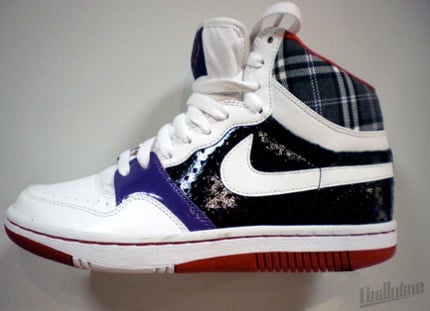
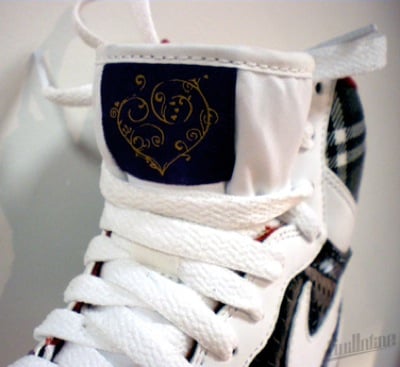
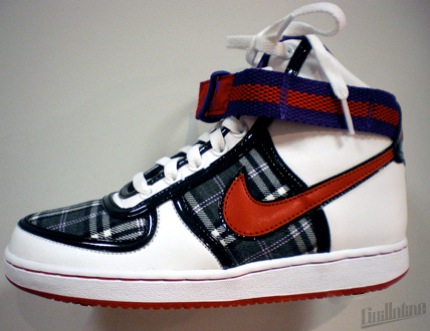
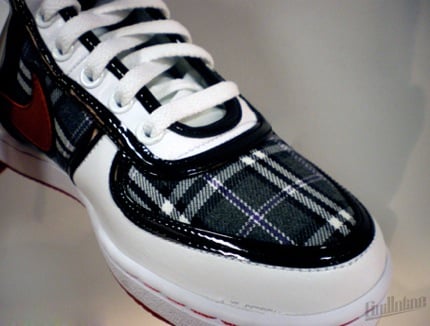
Brands have been using holidays (large and small) as inspiration for certain sneaker colorways and models. adidas, for example, recently prepared a Superstar II in which to celebrate Christmas. But the shoes pictured here are perhaps a part of a holiday still far away. We bring you shots of a Nike Court Force and Vandal that are rumored as being part of 2010’s Valentine’s Day collection. Both shoes come in a high-top model, with the Court Force upper consisting of both patent leather and plaid. Moreover, the Court Force has a heart sketched onto the tongue- a good indication of the holiday it might be released during. The Vandal also consists of a plaid patterning on both the mid panels and the toe box, with a touch of patent leather lining. If these are in fact part of Nike’s Valentine’s Day collection next year, they definitely stray from the conventional pink/red/white colorways, but is that necessarily a bad thing? How do you sneakerheads feel with respect to these two pairs of Nike sneakers?


NikeVDay2
NikeVDay3

NikeVDay4

9/14/2009

DQM x Nike Air Max Current Huarache

The Nike Air Max 90 Current Huarache is bringing the heat over the rest of 2009. A vibrant red edition on the way mimics the tonal black version that released a little while ago, but it’s two classics that are set to steal the show. Like its Hufquake counterpart, the DQM ‘Bacon’ design resurrects a legendary collaboration. These come complete with an array of fleshy tones and don an ‘East’ tongue tag, presumably the compliment to Huf’s ‘West’. These are coming to retailers for the holiday season but you can already grab a sample in US men’s size 9 on eBay.


9/03/2009

ADIDAS History

1949


old adidas placard

The foundation

18 August
- adidas is registered as a company, named after its founder: 'Adi' from Adolf and 'Das' from Dassler.


50s


Adolf Dassler

The 'Miracle of Bern'

1954
- The 'Miracle of Bern' Germany battle Hungary with a competitive advantage. They are wearing adidas soccer boots which for the first time feature removable studs.


60s


high jumper Dick Fosbury

Higher
Driven by a desire to help all athletes committed to performance, adidas manufactures equipment for what some consider "fringe sports". Unconventional high jumper Dick Fosbury launches himself up and over in adidas footwear.


70s


Franz Beckenbauer raising the World Cup

The "adidas" team wins

Crowning moment: Franz Beckenbauer, the "Kaiser", raising the World Cup in victory salute. Germany had just beaten Holland 2-1 in the 1974 final.


80s


old adidas poster

The transition

After Adi Dassler's death, Adi's wife Käthe, his son Horst, and his daughters carry on the business.


90s


Robert Louis-Dreyfus

With a new management

Under the CEO Robert Louis-Dreyfus, adidas is moving from being a manufacturing and sales based company to a marketing company.


1995


adidas logo

adidas goes public

Flotation of the company on the Frankfurt and Paris Stock Exchange.


1996


adidas athelete at the Olympic Games in Atlanta

A splendid year

The "three-stripes company" equips 6,000 Olympic athletes from 33 countries. adidas athletes win 220 medals, including 70 gold. Apparel sales increase 50%.


1997


skateboarder

adidas-Salomon AG

adidas AG acquires the Salomon Group with the brands Salomon, TaylorMade, Mavic and Bonfire in December 1997. The new company is named adidas-Salomon AG.


1999


in-line skaters

The new brands

The integration of the new brands is gaining momentum. The new Taylor Made FireSole clubs boost sales. Salomon in-line skates take off with high double-digit growth during the first half of 1999.


2000


swimmer Ian Thorpe takes three gold medals at the Olympic Games in Sydney

New management

Following personnel changes, the new management initiates an ambitious Growth and Efficiency Program. Major sports events such as the European Soccer Championship EURO 2000™ and the Olympic Summer Games, where swimmer Ian Thorpe takes three gold medals, contribute to the company’s success.


2005


Pole vaulter Elena Isinbayeva becomes the first female to clear 5 metres.

Sale of Salomon

The Salomon Group (including Salomon, Mavic, Bonfire, Cliché and Arc’Teryx) is being sold to Amer Sports in October 2005. The new adidas Group is focusing even more on its core strength in the athletic footwear and apparel market as well as the growing golf category. The legal name of the company will change to “adidas AG” in May/June 2006.


2006


adidas-Salomon AG acquires Reebok

The closing of the Reebok transaction on January 31, 2006 marks a new chapter in the history of the adidas Group. By combining two of the most respected and well-known brands in the worldwide sporting goods industry, the new Group will benefit from a more competitive worldwide platform, well-defined and complementary brand identities, a wider range of products, and a stronger presence across teams, athletes, events and leagues.


By : http://www.miniseen.blogspot.com

Converse history


Along with apple pie, Converse and its shoes are as much a part of America as Coca-Cola. On the face of it, its hard to see why Converse misses the Big Players Chapter, but you need to remember that is is a global tale. This is not to say that Converse is not a vitally important company in sneaker history. Its most famous shoes can be seen all over the world, and the All Star (the biggest selling sneaker of all time) and the Jack Purcell were the first sneakers to pass into the leisure and fashion worlds.

The story of this grand old company begins back in 1908 in the State of Massachusetts. It was in this year that the New Hamsphire-born Marquis Mills Converse founded the Converse Rubber Shoe Company. Mr Converse was quick to latch onto the potential of the rapidly growing rubber shoe industry after having worked at the local Beacon Falls Rubber Shoe store. Wthin two years of establishment, Converse had 350 employees producing tough, rubber-sole, protective footwear under brand names including 'Tuff-e-nuff rubbers'. It was at about this time that the company made the fatal mistake of diversifying into other rubber markets, when it branched into making rubber tryes.


Contrary to popular legend, Converse was not the founding father of the sneaker/trainer industry, even though it was involved in its infancy. The Converse company was launched at a time when baskeetball was, alghough a minority interest, growing in popularity at an astonishing rate. Basketball players were beginning to ultize rubber-soled leisure or deck shoes, and so Converse diversified away form its main interest in industrial shoes and began to produce shoes for this relatively new sport.

t was in 1917 that a vital decision was taken when Converse ssued a icut shoe designed specifially for basketball. This shoe was intended to mantain productivity in the plant when sales of industrial shoes traditionally fell in the summer. The result was the legendary Converse All Star basketball shoe, which is still sold in a familiar form today.

It was in 1971 that ex-basketball player 'Chuck' Taylor joined the company and began selling the new basketball shoes at classes he hell all over the country. Sales boomed, Taylor suggested some additions, such as cushioned heel soles and padding on the ankles, and his signature was added to the shoe - the Chuck Taylor was born. Sales rose again, and Converse as we knnow the company today became a reality.

However, in these early days Converse was more involved in the tyremarket, which proved less than successful. In 1928 the crippling losses of this division took the company into receivership and Marquis Converse left his 'baby'. In 1930, the Stone family became the new owners and stayed in control over the next 40 years, during time Converse survived and grew by buying many other 'rubber compaies, including tyre and footwear firms such as B.F. Goodrich.

By the 1970s Converse had slipped, falling behind firms such as adidas, who were growing on the back of the running-shoe boom. Converse fought back with semi-successful celebrity endorsements by baasketball players like Julius 'Dr J.' Erving, but by the 1980sthere had been many plant closures and Converse had become a small part of larger conglomerate.


However, in 1983 there was a manement buy-out and Converse Inc. came into being. Converse has continued its fight back since that time, developing new shoes. But they will forever be associated with their giant twin classics - the All Star and the Jack Purcell.

In the early 2000s, the multi billion giant company NIKE took over the controlling stage of Converse Inc., and putting it as their subsidiary company..

BY : http://www.miniseen.blogspot.com

NIKE History


Nike’s seeds were sown in Oregon, the USA, by Phil Knight, a middle-distance runner and accounting student at the University of Oregon, and his coach Bill Bowerman. Their friendship changed not only their relationship to sports, but also the technology of producing sports shoes and apparel, and the way in which sports brands promote themselves.


In 1962, having completed his studies, Knight went on a trip around the world. During his stay in Japan, he took up an ambition he had shared with Bill Bowerman - to start importing Japanese running shoes at affordable prices into the US. Knight contacted Onitsuka Tiger. When he was put on the spot and asked about his company, he bluffed his way through and said that he represented Blue Ribbon Sports (BRS) - the first 200 pairs arrived in the US in December 1963. This was a turning point, and with Knight and Bowerman having invested around $500 each, the company rapidly gained a great reputation with college athletes. Before long, Bowerman was dreaming of ways to improve the design of Onitsuka shoes, and Knight was dreaming of how much more profitable it would be to produce and sell their own shoes.


In 1971, a company employee, Jeff Johnson, thought up the name Nike (apparently while he slept), after the Greek goddess of victory. Caroline Davidson, who met Knight when she was a student attending the same university, was asked to design a logo. She came up with the now world-renowned swoosh - the Nike name and brand were born.
In 1972, following a split from Onitsuka Tiger, the Moon Shoe debuted at the US Olympic Trials. A year later, the middle-distance runner Steve Prefontaine became the first major athlete to wear Nike shoes. In 1974, Bowerman dreamt of a new innovation for the outsole, made by pouring rubber into a waffle iron to create a waffle outsole (go to the Waffle Trainer on page 100 to see how that simple experiment spawned one of the greatest sneaker designs). By 1978, Nike had started to sell its products internationally.


Kenyan marathon runner Henry Reno broke four world records wearing Nike shoes. Tennis ace John McEnroe started to wear Nike products,broadening the brand’s visual appeal in the tennis arena. In 1979, the Taiiwind shoe became the first running shoe to be launched with a patented air sole. In 1985, Michael Jordan signed with Nike as a rookie, and a whole new line of shoe apparel was created. The Air Jordan basketball shoe became one of the world’s most popular sneakers.
The Nike Air Max was brought out in 1987, along with Nike’s first multipurpose shoe, the Air Trainer . Both catapulted Nike ahead of the competition. The brand has continued to be a leader in sports design and innovation, and has been endorsed by many of the world’s most famous sports stars, including Andre Agassi, Ronaldo and Tiger Woods.
Nike’s strengths are threefold: an undoubted intuitive sense of what athletes want and need (something that goes all the way back to the track in Oregon), a commitment to technical innovation, and an attitude and outlook towards branding and marketing that has changed the way sports shoes and apparel are promoted forever.


By - http://www.miniseen.blogspot.com